
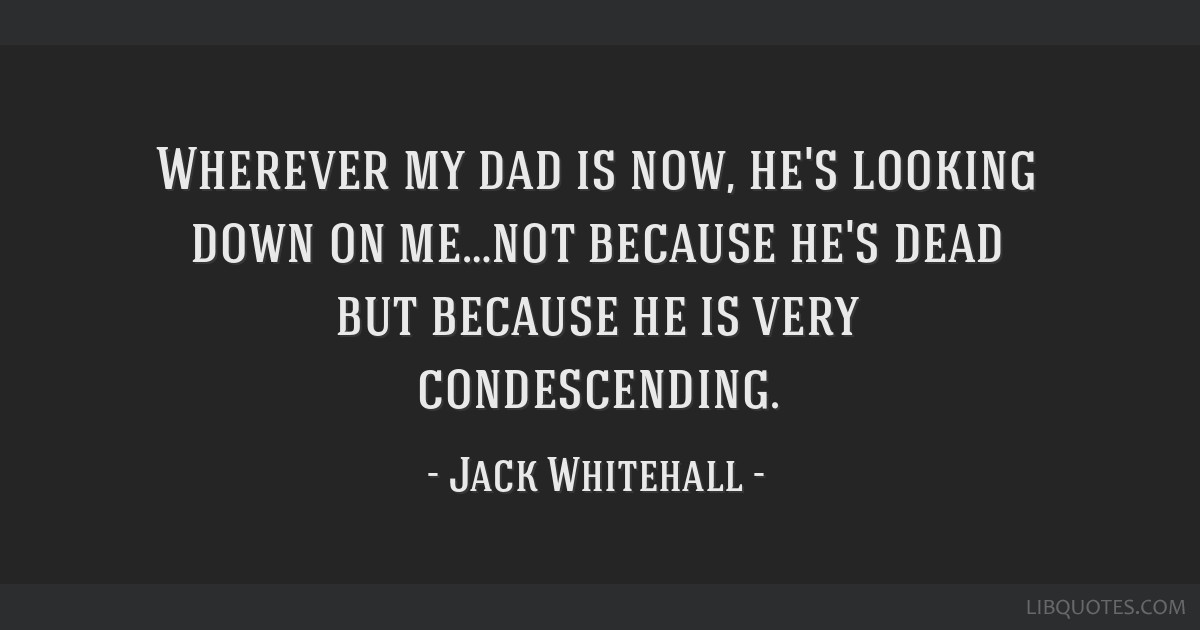
Jack Whitehall once joked, “I’m sure wherever my dad is, he’s looking down on us. He’s not dead—just very disappointed.” It’s a line delivered with his signature deadpan snark, but peel back the laughter and you uncover a layered commentary on family, truth, performance, and the masks we wear in professional and personal life. This isn’t just a punchline. It’s a quote of the day that distills sharp observations about honesty, dysfunctional work culture, and the contradictions of human nature—wrapped in the velvet coat of British comedy.
The real power of Whitehall’s humor lies in its ability to expose uncomfortable truths through absurdity. When he mocks his father’s judgmental presence—even in metaphorical heaven—he’s not just roasting Michael Whitehall. He’s highlighting a universal experience: the invisible authority figures who shape our behavior, long after we’ve left home or entered adulthood.
This quote, like much of his material, works on multiple levels. On the surface: a laugh. On reflection: a mirror.
Let’s dissect what makes this single quote resonate far beyond the comedy club.
Why This Quote Stands Out in Modern Comedy
Comedy today often leans on shock value or topical outrage. Jack Whitehall’s style is different. He relies on self-deprecation, class satire, and the tension between emotional repression and performative honesty. His relationship with his father—frequently the centerpiece of his stand-up, Netflix specials like Jack Whitehall: I’m Only Joking, and the travel series Travels with My Father—is a narrative engine for exploring deeper truths.
The “looking down on us” quip is a masterclass in subverting expectations. The phrase “he’s looking down on us” usually implies a deceased loved one watching from beyond. Whitehall flips it: his dad is very much alive, but emotionally distant—critical, reserved, and perpetually unimpressed. The humor comes from that dissonance. But so does the insight.
Most people don’t laugh solely because it’s funny. They laugh because it’s true.
Think about the last time you said, “My boss would hate this,” before doing something slightly rebellious at work. Or how you still hear your mother’s voice when you leave a light on. These psychological echoes shape behavior more than policies or paychecks.
Honesty Through the Lens of Comedy
Whitehall doesn’t claim to be a truth-teller in the traditional sense. He’s a satirist. Yet his comedy often reveals more honesty than straight-faced self-help gurus.
Consider the contradiction: he mocks his father’s rigidity, yet structures his life around earning his approval. That duality is human nature in a nutshell. We resist authority, yet crave validation from those who raised us.
In work environments, this plays out constantly: - Employees perform diligence they don’t feel, just to avoid the boss’s frown. - Leaders project confidence while privately doubting every decision. - Teams prioritize optics over outcomes because “that’s what leadership wants to see.”
Whitehall’s joke underscores a core principle: emotional honesty is rare, even when we’re not lying.
Too many workplaces equate professionalism with emotional suppression. The result? A culture where people say “I’m fine” while drowning in burnout. Where feedback is sugar-coated until it loses all meaning. Where leadership resembles Michael Whitehall—handsome, well-dressed, and utterly inscrutable.
The irony? The most productive teams aren’t the quietest. They’re the ones where people can say, “Actually, I think we’re heading in the wrong direction.” Like Jack finally confronting his dad’s emotional reserve on a mountain in Bhutan.
Work Culture: When Approval Replaces Purpose
In Travels with My Father, Jack pushes his reserved, upper-class father into increasingly absurd adventures: zip-lining, dancing in Bangkok, skinny-dipping in Iceland. The premise is comedic, but the subtext critiques a very British affliction—emotional restraint masquerading as strength.
Now apply that to corporate culture.
How many organizations reward stoicism over vulnerability? Where admitting uncertainty feels like weakness? Where innovation stalls because no one wants to be the first to suggest something “silly”?
Whitehall’s dynamic with his dad mirrors dysfunctional workplace hierarchies: - The distant authority figure (CEO/father) who communicates through silence or dry remarks. - The subordinate (employee/son) who interprets every glance as judgment. - A relationship built on performance, not dialogue.
Real example: A marketing team kills a bold campaign because they assume the CMO “won’t get it.” No one asks. No one tests it. They default to safe, stale content—just like Jack assumes his dad would disapprove of stand-up comedy.
The cost? Stagnation. Missed opportunities. Emotional disconnection.
The fix? Build cultures where questions are valued more than assumptions. Where leaders say, “I don’t know—what do you think?” And where employees feel safe enough to respond honestly.
Jack’s comedy works because it’s personal. Workplaces thrive when they embrace that same principle: personal doesn’t mean unprofessional. It means human.
Human Nature: We’re All Performing
One of Whitehall’s greatest insights—delivered through laughter—is that we’re all playing roles.
He plays the flamboyant, over-the-top comedian. His dad plays the stoic, disciplined gentleman. But both are performances shaped by expectation, era, and class.
This extends far beyond family dynamics.
In work settings: - The “always-on” employee performs productivity—even when burnt out. - The “chill” startup founder performs nonchalance, masking deep anxiety. - The DEI leader performs inclusivity, while their team remains homogenous.
Performance isn’t inherently bad. It’s part of social cohesion. But problems arise when the mask becomes permanent.
Psychologists call this emotional labor—the effort to regulate emotions to meet job expectations. Flight attendants smile during turbulence. Nurses stay calm in chaos. Comedians joke about their trauma.
Jack Whitehall does all three.
But here’s the twist: by exposing his own performance, he disarms the audience. When he says, “He’s not dead—just very disappointed,” he’s acknowledging the script. That self-awareness is the first step toward authenticity.
Organizations need more of that.
Instead of demanding constant positivity, imagine a workplace where: - Leaders admit mistakes on team calls. - Employees can say, “I’m not okay today,” without fear. - Feedback flows both ways, without hierarchy blocking the path.
It starts with someone breaking character. Just like Jack did.
The Class Dimension: British Comedy as Social Commentary
You can’t discuss Jack Whitehall without addressing class.
His humor hinges on the collision between old-world British elitism (embodied by his father) and modern, expressive individualism (embodied by him). That tension isn’t just familial—it’s cultural.
Michael Whitehall was a powerful talent agent, part of London’s entertainment elite. Jack grew up in privilege, attended private schools, spoke with a received pronunciation accent. Yet his comedy mocks that world relentlessly.
Why?
Because privilege doesn’t insulate you from emotional neglect.
And that’s a critical life lesson: wealth and status don’t guarantee connection. In fact, they often obstruct it. The same culture that values polished appearances in comedy clubs also rewards polished P&Ls over honest conversations in boardrooms.
Whitehall’s work culture satire is subtle but sharp: - The obsession with image. - The fear of appearing “common.” - The refusal to show emotion, even when it’s warranted.
These aren’t just dad jokes. They’re critiques of a system where form outweighs function.
Nowhere is this clearer than in British workplaces, where “keeping a stiff upper lip” can mean ignoring burnout, bullying, or bad strategy—just to maintain decorum.
Jack’s comedy says: What if we stopped performing? What if we just talked?
Practical Takeaways: What We Can Learn
Whitehall’s quote isn’t just a laugh. It’s a behavioral blueprint.
Here’s how to apply it:
#### 1. Name the Unspoken When you sense tension, call it. “I get the feeling you’re not sold on this idea. Am I right?” Like Jack confronting his dad’s silence, addressing the invisible lifts the weight.
#### 2. Reward Honesty, Not Just Performance Recognize employees who speak up, not just those who hit targets. Create “safe to fail” zones where ideas can be tested without career risk.
#### 3. Audit Your Emotional Labor Ask: Are people here performing happiness? Anonymous pulse surveys, open forums, and leadership vulnerability can reduce emotional strain.
#### 4. Use Humor to Reveal, Not Escape Don’t use jokes to deflect pain. Use them to expose it—like Whitehall does. A well-placed, self-aware quip can open doors that lectures cannot.
#### 5. Normalize Discomfort Growth happens outside comfort zones. If no one’s slightly awkward in meetings, you’re probably avoiding hard truths.
Final Thought: The Wisdom in the Joke
Jack Whitehall’s quote—“I’m sure wherever my dad is, he’s looking down on us. He’s not dead—just very disappointed.”—is more than a viral one-liner. It’s a cultural artifact. A lens into the British psyche. A commentary on the families we come from and the workplaces we inherit.
It reminds us that honesty doesn’t have to be solemn to be true. That laughter can carry wisdom. And that sometimes, the people who love us most make us feel like we’re never quite enough—until we finally ask why.
So the next time you hear someone say, “My boss is going to kill me,” pause. Ask: Are they really? Or are they just… disappointed?
Then ask yourself: What performance are you stuck in? And who’s really watching?
Break character. Start speaking. The best work—and the best life—starts with that first honest line.
FAQ
What should you look for in Jack Whitehall's Quote of the Day: Humor, Truth, and Life Lessons? Focus on relevance, practical value, and how well the solution matches real user intent.
Is Jack Whitehall's Quote of the Day: Humor, Truth, and Life Lessons suitable for beginners? That depends on the workflow, but a clear step-by-step approach usually makes it easier to start.
How do you compare options around Jack Whitehall's Quote of the Day: Humor, Truth, and Life Lessons? Compare features, trust signals, limitations, pricing, and ease of implementation.
What mistakes should you avoid? Avoid generic choices, weak validation, and decisions based only on marketing claims.
What is the next best step? Shortlist the most relevant options, validate them quickly, and refine from real-world results.